The Economics of Remittances

Definition

According to Wikipedia, Remittances are transfers of money by foreign workers to their home countries. Remittances (also known as current transfers) include worker’s remittances and other private transfers on the current account. [Gupta 2006]


The Indian scenario

Remittances to India have increased at about 13 per cent a year since 1991, making India one of the largest recipients of remittances in the world. They have been the most stable type of external flows in India. They have been crucial in improving the current account and in the consequent build-up of foreign exchange in the last few years.


The effect of remittances on output and employment generation would depend on the end-use of the transfers. The effect would be larger if remittances are geared more toward investment expenditure.


In terms of percentage of GDP, remittances equaled about 3 per cent in 2003.


[These are excerpts from Poonam Gupta’s ‘Macroeconomic Determinants of Remittances‘ which came in the EPW.]


The Kerala scene


The great exodus of Keralites to the Gulf Countries during the 1970s oil boom was to a large extent possible because of the benefits these workers had gained from growing up in Kerala (better health and education, and more awareness of opportunities beyond their state). The money they send back today makes up 25% of the state budget, and one third of all remittances to India. It has not only helped to stimulate consumption levels in Kerala, which are among the highest in country, but it has also kick-started the boom in the tertiary (or service) sector of industry ‘IT, tourism, banking, private health care, etc. ‘ that has been the driving force behind Kerala’s economic growth spurt. While neither the manufacturing industry nor agriculture has experienced any significant growth over the past decade, the service sector now makes up something like 65% of the state economy, and has since 1986 until today gone from a growth rate of 3.25% to 7.5%. The remittances also probably served to underestimate Kerala’s economy throughout the financial dark ages, since they do not count directly towards the GDP. [Blomqvist 2006]


Reasons

Obviously, the most common motivation to remit is simply that migrants care of those left behind: spouses, children, parents, and members of larger kinship and social circles. First of all, remittances may just ‘buy’ a wide range of services such as taking care of the migrant’s assets and relatives at home, with the likelihood and size of remittances depending on whether and when the migrant intends to return. Secondly, it is clear that migration is primarily (but not only) driven by wage differentials, implying that people are ready to incur substantial moving costs in order to access to international migration. [Rapoport and Docquier 2005]

The main results established in the literature are: remittances are motivated more by an altruistic motive than by an investment motive; remittances are counter-cyclical, i.e., higher under adverse economic outcomes in the native country; they are used more for consumption than for investment; and they do not respond much to relative rates of return on investment in the home country. [Gupta 2006] This result is supported by The Hindu Business Line which says that ‘Unlike the capital flows, interest rate differentials are not found to be significant in determining the workers remittances, thus underlining the stable nature of these flows.’


A trade off’

Migration to other countries take place mainly when there are better employment avenues abroad. This usually takes place after the individual has completed his education. Large scale migration has been criticized by imposing on them the ‘brain drain’ stamp.


Thus when migration takes place, the home country is losing a significant chunk of its educated labour force. In developing countries like India, there is much to be done; but since the addition to labour force happens at a faster rate than the increase in employment opportunities, this ‘migration’ tends to become inevitable.


A trade off is evident between ‘brain drain’ and ‘remittances’. Though ‘brain drain’ is said to have a considerable pressure on the home economy (By withdrawing educated labour force) remittances tend to improve standard of living in the home country. But usually remittances better the standard of living of the ‘dependent population’. They do not affect or increase the productive capacity of the Indian economy directly, but they affect it indirectly through increased consumption.


Illegal flows

Unofficial remittances are sent through friends or migrants themselves or through traditional networks, known in some countries as hawala or chiti, which allow money deposited with a trader in one country to be paid out by a partner in the recipient country. [Mutume 2005]


Hawala is an informal banking system in which funds are transferred internationally, without being moved physically. Hawala brokers, whose relationships are based in part on trust, maintain running accounts with one another. Once a sender deposits funds with a hawala broker, the broker contacts another hawala broker in the relevant location and requests the dispersal of funds to the recipient. Hawala brokers employ fast methods of communication, such as phone or fax. The main users of the hawala system reside in the developed world and transfer funds to recipients in the developing world. [Fugfugosh 2006]


Conclusion

The increased inflow of remittances is what is fuelling the ‘consumption boom’ in India. The fact that the SENSEX is bullish and the real estate markets are booming are proof to this. (There has not been any proportionate increase in the intrinsic values. They might be a bubble which is financed almost to a large extent by remittances.) Adequate studies should be targeted at such interrelationships between remittances and various markets in the home country, so that the small investors do not incur huge losses.


Since, these remittances are relatively stable, this consumption boom will tend to sustain for longer periods. Moreover, these remittances are said to be one of the main reasons for lowering poverty. For example, remittances enhanced the standard of living of the people in Kerala. They also contributed to development in African countries.


The government is trying to improve the investment benefits accruing to the expatriates with a hope of increasing the flow of remittances. There is no doubt that remittances are beneficial to the receiving country.


Recipients spend these funds (remittances) in various ways: for some, remittances are their lifeline, without which they do not eat, as in Somalia; for others, remittances are transferred home specifically to be invested in savings schemes with attractive incentives, as in India. In Cape Verde, migrant remittances contributed to political change of the oppressive island government while for people from other countries, remittances are directed to community infrastructure development, such as collective projects in Mexico. These illustrations convey the message that in all corners of the globe, remittances are a precious tool for every single recipient and that the secure flow of remittances must be assured. [Fugfugosh 2006]


Thus for countries like India where additions to employment opportunities take place at a slow pace, migration will take place. Providing better investment avenues for these expatriates will help, although not significantly in bettering the flow of remittances. Moreover, by making such inflows easy and transparent, the unofficial inflows will reduce. Targeting these remittances and channeling them to socially productive investment avenues such as education and health will improve the condition of the Indian populace.


References

1) Steady rise in NRI remittances, The Hindu Business Line, 29th January 2004.

2) The Economics of Migrants’ Remittances, Hillel Rapoport and Fr’d’ric Docquier, March 2005.

3) Welfare and banana leaf thalis ‘ a foreign student’s take on Kerala, Part 1, Olof Blomqvist, 2006.

4) Informal Remittance Flows and Their Implications for Global Security, Miriam Ahmed Fugfugosh, 2006.

5) Workers’ remittances: a boon to development, Gumisai Mutume, 2005.

Indian Economic History: Part 2

The previous post on Indian Economy during the British period revealed one of the reasons for widespread penury in the country at the time of independence. This post is second in the series on Indian Economic History. A major reason for the presence of very wide inequalities of income and wealth concomitant to abject poverty was due to the Land Tax levied by the British Government.

On Land Tax

After the deterioration of the Indian manufacturing sector owing to policies framed by Britain, Agriculture was the sole source of national wealth.

The Land Tax levied was not only excessive by outrageous. In England the Land Tax rates were between 5% and 20% whereas in India, they levied exorbitant rates which were over 90% of the produce. This crippled the Indian Agriculture. This ensured that the cultivators got zilch from cultivation.

The main characteristics were

1) It was heavy as in the rates were too high.

”” 2) The rates were uncertain. The tax rates were changed very now and then. There was absolutely no transparency in the proceedings.

Moreover, this Land Tax differed from the principle of taxation which prevailed in all well administered countries.

In addition to all this, the revenue from Land Tax was never used for the betterment of the Indian populace. This left the cultivators permanently poor.

Lagaan

The movie portrays the large chunks of monies which were taken as tax from the Indian peasants. Life during the colonial rule was certainly hard for them. This was not caused by mismanagement but in fact it was maneuvered cleverly by the British.

Conclusion

The effects of the Land Tax were wide spread. They not only robbed the cultivators of their harvest but also discouraged them to cultivate. This had serious negative impact on production and productivity. Thus we know that, Colonial rule played a very important role in destroying agriculture and industry in India. This resulted in India being shunned from international trade as the products were no longer ‘price’ competitive.

References

1) The Economic History of India By R.C. Dutt


Indian Economic History:Part 1

The decline of Indian manufacturing sector

This post will be one among a series of posts relating to the Indian economic history based on the book by Romesh Chunder Dutt called ‘The Economic History of India.'[Published 1902]

Being cognizant of what happened to the economy during the British rule in India will enable us to understand the causes and reasons of some of the contemporary social and economic issues. A thorough understanding of the British policies in India will bring to the fore the reasons why India, a relatively strong and mighty country earlier, faced famines, debts, etc.

This post tries to examine certain historical incidents brought out by Dutt in relation to the current socio-economic framework.

The Englishmen introduced western education, built a strong and efficacious administration, framed wise laws and also established courts of justice.

India encountered famines during the years 1877, 1878, 1889, 1892, 1897 and 1900 which carried off more than 15 millions of people.’
Though British introduced such efficient institutions, India lost millions of lives in the famines. Famines further aggravate poverty and also undermine the confidence on the Government.

Sources of wealth have been narrowed under British rule.’
Though they provided India with efficient enterprises, they thoroughly looted India of all its wealth. The British rule proved to be a lacuna in the growth of India which further accelerated and aggravated problems like high external debts, droughts even after Indian independence.

India was a great manufacturing as well as an agricultural country in the 16th century.’ ‘Indian loom supplied the markets of Asia and Europe.’
The manufacturing sector is increasingly dependent on the agricultural sector for raw materials. The demand for manufactured goods predominantly comes from the primary sector. Most of the populace was engaged in agricultural activities, and due to this they enjoyed a considerable ‘Demand capacity’, which provided them with the sufficient ‘purchasing power’ to consume manufactured products. This sort of a healthy relation between the 2 sectors is sustainable in the long run, rather than an economy which depends heavily on a single sector. Of late, the rhetoric has been to increase GDP growth rates, without mentioning the importance of contributions from Agriculture to these growth rates.

East India Company and the British parliament, followed selfish commercial policy which discouraged Indian manufacturers.’ ‘An excise duty was imposed on Indian cotton fabrics which disabled then to compete with Japan and China.’
The British ruined the manufacturing sector by imposing heavy duties on its exports thus making it costly in the global market. Owing to the fact that India had abundant natural resources, Agriculture could not be strangled.

British made Indian people grow raw produce only.’
This enabled them to purchase cheap raw materials and had it processed in England which was later sold for exorbitant rates in India and elsewhere.

Millions of Indian artisans lost their earnings.‘ ‘The invention of the power loom in Europe completed the decline of the Indian industries.’

Thus the Indian manufacturing sector was almost reduced to nothing by the end of 1947.

Advances in Economic History

A new branch of Economics, namely ‘Cliometrics’ which refers to the systematic use of economic theory and econometrics techniques to study economic history has helped economic historians in increasing the accuracy of their findings.

The Royal Swedish Academy of Sciences awarded the Bank of Sweden Prize in Economic Sciences in Memory of Alfred Nobel for 1993 jointly to Professor Robert W. Fogel, University of Chicago, USA, and Professor Douglass C. North, Washington University, St. Louis, USA, “for having renewed research in economic history by applying economic theory and quantiative methods in order to explain economic and institutional change.” [Nobelprize.org]

Further Links

1) The Cliometric society
2) Cliometrica (Journal of Historical Economics and Econometric History)

Special Economic Zones (SEZ)

This post’is based on an article titled ‘Special Economic Zones: Revisiting the Policy Debate‘ which came in the ‘Economic and Political Weekly‘ authored by Aradhna Aggarwal.


The discontents against the SEZs are


1) This will bring about a significant revenue loss to the government. This will result in a kind of ‘disguised industry’ just as ‘disguised unemployment’. There will not be adequate production quid pro quo of the investments undertaken.


2) This will not only ruin various societies of their livelihood, but will also contribute to escalating inequalities and poverty. Moreover, relief and rehabilitation is to be provided by the SEZ developer. How far this will be successful is questionable.


3) This not only affects the people living in the proximity but also the agricultural sector as a whole. Of late, there has not been much growth in agriculture. This, like the author posits, will have serious implication for food security.


4) This will exacerbate the income and wealth inequalities. Moreover, since the public does not have access to the proceeding of SEZ’s, it will be difficult to ensure if the remaining 65% area is being used for productive purposes. [For that matter ensuring the 35% will prove difficult]


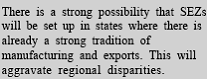
The trend is already seen in the initial approvals. The share of the four most industrialised states (TN, Karnataka, Gujarat and
Maharashtra) in total approvals is 49.5 per cent. Andhra Pradesh, Kerala and Haryana account for another 31.1 per cent of total approvals. Thus seven states account for 80.6 per cent of approvals. Their share of in-principle approvals is 63.8 per cent. On the other hand, industrially backward states of
Bihar, north-east and J and K do not have a single approval.


Thus not only do these SEZ’s worsen the lives of significant number of people, but also contribute to widening regional disparities and that too all at a cost to the government and people.

[Since a reader had requested me to discuss about SEZ’s, I thought of writing this post; though it is late.]