Indian Economic History:Part 1

The decline of Indian manufacturing sector

This post will be one among a series of posts relating to the Indian economic history based on the book by Romesh Chunder Dutt called ‘The Economic History of India.'[Published 1902]

Being cognizant of what happened to the economy during the British rule in India will enable us to understand the causes and reasons of some of the contemporary social and economic issues. A thorough understanding of the British policies in India will bring to the fore the reasons why India, a relatively strong and mighty country earlier, faced famines, debts, etc.

This post tries to examine certain historical incidents brought out by Dutt in relation to the current socio-economic framework.

The Englishmen introduced western education, built a strong and efficacious administration, framed wise laws and also established courts of justice.

India encountered famines during the years 1877, 1878, 1889, 1892, 1897 and 1900 which carried off more than 15 millions of people.’
Though British introduced such efficient institutions, India lost millions of lives in the famines. Famines further aggravate poverty and also undermine the confidence on the Government.

Sources of wealth have been narrowed under British rule.’
Though they provided India with efficient enterprises, they thoroughly looted India of all its wealth. The British rule proved to be a lacuna in the growth of India which further accelerated and aggravated problems like high external debts, droughts even after Indian independence.

India was a great manufacturing as well as an agricultural country in the 16th century.’ ‘Indian loom supplied the markets of Asia and Europe.’
The manufacturing sector is increasingly dependent on the agricultural sector for raw materials. The demand for manufactured goods predominantly comes from the primary sector. Most of the populace was engaged in agricultural activities, and due to this they enjoyed a considerable ‘Demand capacity’, which provided them with the sufficient ‘purchasing power’ to consume manufactured products. This sort of a healthy relation between the 2 sectors is sustainable in the long run, rather than an economy which depends heavily on a single sector. Of late, the rhetoric has been to increase GDP growth rates, without mentioning the importance of contributions from Agriculture to these growth rates.

East India Company and the British parliament, followed selfish commercial policy which discouraged Indian manufacturers.’ ‘An excise duty was imposed on Indian cotton fabrics which disabled then to compete with Japan and China.’
The British ruined the manufacturing sector by imposing heavy duties on its exports thus making it costly in the global market. Owing to the fact that India had abundant natural resources, Agriculture could not be strangled.

British made Indian people grow raw produce only.’
This enabled them to purchase cheap raw materials and had it processed in England which was later sold for exorbitant rates in India and elsewhere.

Millions of Indian artisans lost their earnings.‘ ‘The invention of the power loom in Europe completed the decline of the Indian industries.’

Thus the Indian manufacturing sector was almost reduced to nothing by the end of 1947.

Advances in Economic History

A new branch of Economics, namely ‘Cliometrics’ which refers to the systematic use of economic theory and econometrics techniques to study economic history has helped economic historians in increasing the accuracy of their findings.

The Royal Swedish Academy of Sciences awarded the Bank of Sweden Prize in Economic Sciences in Memory of Alfred Nobel for 1993 jointly to Professor Robert W. Fogel, University of Chicago, USA, and Professor Douglass C. North, Washington University, St. Louis, USA, “for having renewed research in economic history by applying economic theory and quantiative methods in order to explain economic and institutional change.” [Nobelprize.org]

Further Links

1) The Cliometric society
2) Cliometrica (Journal of Historical Economics and Econometric History)

Special Economic Zones (SEZ)

This post’is based on an article titled ‘Special Economic Zones: Revisiting the Policy Debate‘ which came in the ‘Economic and Political Weekly‘ authored by Aradhna Aggarwal.


The discontents against the SEZs are


1) This will bring about a significant revenue loss to the government. This will result in a kind of ‘disguised industry’ just as ‘disguised unemployment’. There will not be adequate production quid pro quo of the investments undertaken.


2) This will not only ruin various societies of their livelihood, but will also contribute to escalating inequalities and poverty. Moreover, relief and rehabilitation is to be provided by the SEZ developer. How far this will be successful is questionable.


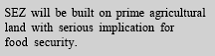
3) This not only affects the people living in the proximity but also the agricultural sector as a whole. Of late, there has not been much growth in agriculture. This, like the author posits, will have serious implication for food security.


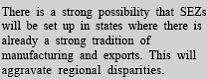
4) This will exacerbate the income and wealth inequalities. Moreover, since the public does not have access to the proceeding of SEZ’s, it will be difficult to ensure if the remaining 65% area is being used for productive purposes. [For that matter ensuring the 35% will prove difficult]


The trend is already seen in the initial approvals. The share of the four most industrialised states (TN, Karnataka, Gujarat and
Maharashtra) in total approvals is 49.5 per cent. Andhra Pradesh, Kerala and Haryana account for another 31.1 per cent of total approvals. Thus seven states account for 80.6 per cent of approvals. Their share of in-principle approvals is 63.8 per cent. On the other hand, industrially backward states of
Bihar, north-east and J and K do not have a single approval.


Thus not only do these SEZ’s worsen the lives of significant number of people, but also contribute to widening regional disparities and that too all at a cost to the government and people.

[Since a reader had requested me to discuss about SEZ’s, I thought of writing this post; though it is late.]

The Economics of the Environment

Of late, hues and cries are being heard in relation to the Environment. A crisis is impending. The Environment plays an important role in every economy. The recent HDR 2006 stresses on ‘Climate Crisis’.

Developments, a magazine produced by the Department for International Development (DFID) brings out some alarming statistics to show how ‘climate change’ threatens the world’s poor.

1) 97% of all deaths from natural disasters are in poor countries.
2) Longer rainy seasons have already led to increased malaria in parts of Rwanda and Tanzania.
3) Over 3 billion people in the Middle East and the Indian sub-continent could be facing acute shortages of water-affecting productivity and jobs.
4) Climate change brings the risk of increases in serious diseases such as malaria, dengue, yellow fever and polio.
5) A temperature rise of 2-3.5 degree Celsius would reduce farmers’ incomes by between 9 and 25%.
6) The area of the world stricken by drought has doubled between 1970 and the early 2000s.
7) There are over a billion people living without access to clean, safe water and 2.6 billion people have nowhere to go to the toilet.

These numbers prove that the ecosystem has been seriously affected by various kinds of pollution. This also warrants the need for generating energy using environmental-friendly methods.

India and the Environment

Studies conducted by WWF, available exclusively with CNN-IBN reveal that the Gangotri glacier is receding at an alarming average rate of 23 meters every year. [Iyer 2006] Glaciers are considered to be indicators of Global Warming.

Orissa enjoys unrivalled natural resources and have proved attractive to industrial giants. It has the highest overall poverty ratio in the country, with 48% living below the poverty line; its level of infectious diseases and malnutrition is alarming; it is particularly prone to natural disasters, such as cyclones and floods, says Prodeepta Das in his article ‘Counting the cost’ in Developments.

India on Tuesday became part of a seven-member international consortium to launch a multi-billion dollar experimental fusion reactor called ITER. The aim of the research reactor is to create fusion technologies that could emulate the power of the sun, that is, to develop a source of limitless, clean energy. [Naravane 2006]

It is of utmost importance that India strives to undertake research in resource economics so as to develop processes which will prove to be environment friendly. Jonathon Porritt, in his article in Developments titled ‘Capitalism for the poor” posits that ‘The end of cheap oil means the end of easy economic growth.’ Thus it is important that nations start finding alternative avenues to harness energy.

Green Tax: The state of Andhra Pradesh is introducing ‘green tax’ from 27th of November. This will be levied on vehicles which have been in use for 15 years and above. The revenue from this would be used for pollution control activities. This is a very beneficial tax which needs to be introduced in the whole of India.

Environmental protection efforts

The 1997 Kyoto Protocol expects it’s signatories to limit or reduce their greenhouse gas emissions. This protocol is yet to be ratified by many of the ‘major polluting’ nations.

The film ‘An Inconvenient Truth‘ directed by Davis Guggenheim and featuring Al Gore portrays the effects of global warming and its related hazards.

Many multinational and transnational companies are involved in such environmental protection. The effects of such activities are yet to be seen.

Concepts in Environmental Economics

Environmental economics is concerned with the impact of the economy on the environment, the significance of the environment to the economy, and the appropriate way of regulating economic activity so that balance is achieved among environmental, economic and other social goals. [Kolstad 1999]

Pigovian tax:
Early in the twentieth century the English economist Arthur C. Pigou argued for the imposition of taxes on generators of pollution. Since the social cost of pollution is in excess of the private cost to the polluter, the government should intervene with a tax, making pollution more costly to the polluter. If the pollution is more costly to produce, the polluter will produce less pollution. This tax has come to be called a Pigovian fee or Pigovian tax. [Ibid]

Other concepts like Coase theorem (Ronald H. Coase, Nobel winner of 1991), Ratchet effect are also present. The ratchet effect occurs when the regulator has incomplete knowledge of the firms’ costs and the two must repeatedly interact. [Ibid]

Conclusions

Thus it is indeed in the interest of everyone to protect the environment. Planting trees, abstaining from burning plastic, reducing travel by vehicles whenever possible are some of the things we could do to reduce pollution. Environmental hazards have a significant impact on the economy and in particular those of the poor countries. Though most of the pollution is done by the advanced countries, it is the ‘other countries’ which mostly bear the brunt.

Resources on Environmental economics

1) Environmental Economics (Blog)
2) Association of Environmental and Resource Economists (AERE)
3) Economist’s view (Blog)

Further Links

1) Creative Taxing Can Save the Environment

2) STERN REVIEW: The Economics of Climate Change

Economics and Karl Marx

History is economics in action.’ ‘ Karl Marx

The discipline of Economics has been improved upon by many individuals who have not been economists. One among them is Karl Marx (1818-83). Marx contributed to sociology, history, philosophy, literature and even arts. This article tries to bring out to the fore a few of his contributions and criticisms regarding Economics.

Marx’s theories revolved around the relationship between capitalist and worker. He posited that this relationship is an unstable one, as each sees the other as a rival. During his time, money and bargaining was associated with the Jews and they dominated the society. Marx suggested a reorganisation of society so as to do away with the evils of bargaining, which almost eventually resulted in the worker getting exploited.

The property owning middle class could win freedom for themselves on the basis of rights to poverty- thus excluding others from the freedom they gain- the property less working class possess nothing but their title as humanity. Such was Marx’s view of the exploited proletariat. Marx claimed that ‘total deprivation’ was a universal characteristic of the proletariat. [Singer 2006]

Marx began his critical study of economics in 1844. Marx criticised classical economic theories stating that they characterised worker as a commodity, the production of which is subject to the ordinary laws of supply and demand. [Singer 2006]

Marx contended that the main problems in the economy were caused due to the unequal ownership of private property. He wanted to abolish private property and to also regulate production. The solution he gave was ‘Communism’ in the ‘Communist Manifesto’ written jointly with Friedrich Engels. He also viewed the labourer and their labour as one. And one of the questions he posed was whether the labour was more important than the labourer.

Theory of Surplus value

Surplus-value is the social product which is over and above what is required for the producers to live.

The measure of value is labour time, so surplus value is the accumulated product of the unpaid labour time of the producers. In bourgeois society, surplus value is acquired by the capitalist in the form of profit: the capitalist owns the means of production as Private Property, so the workers have no choice but to sell their labour-power to the capitalists in order to live. The capitalist then owns not only the means of production, and the workers’ labour-power which he has bought to use in production, but the product as well. After paying wages, the capitalist then becomes the owner of the surplus value, over and above the value of the workers’ labour-power.

The capitalists may increase the amount of surplus value extracted from the working class by two means: (1) by absolute surplus value ‘ extending the working day as long as possible, and (2) by relative surplus value ‘ by cutting wages.

On Division of Labour

Marx talked about the ill effects of Specialization. He posited that increasing division of labour eliminates intellectual and manual skill and reduces the labourer to a mere appendage to a machine. [Singer 2006]

Looking at this statement, I feel it holds good even now. If a labourer could learn two or more trades, it is possible for him to perform efficiently in all the trades, except for the fact that, he would not be able to devote his entire time to a single trade. In this age, seldom do we come across people who are economists as well as physicists or historians as well as doctors, etc. ‘Specialization’ is said to be the need for the day.

Taking the case of a manual labourer in India, if he knows two trades, he would be better off. The labourer will be in a better bargaining position than otherwise.

Thoughts

Marx was of the view that we need to produce things for their use-value and not for their exchange-value. This is what he tried to achieve by Communism. But Communism rendered human inventions and innovations as useless. Though, people all had the basic necessities of life, they did not have the motivation or the zeal to bring out the best in them.

His insights of Classical Political Economy are laudable. A science progresses when it is criticized and when it’gets defended.

Writings in Economics

1) Das Kapital
2) Critique of Political Economy
3) Grundrisse

References

1] Marx: A very short introduction-Peter Singer
2] Encyclopedia of Marxism