Division of Labour: some comments

Division of labour is generally associated with Adam Smith (1776). The concept of division of labour attains significance because it helps in formulating an endogenous growth model, along with the extent of the market. The idea is that specialization has a positive effect on the extent of the market, which in turn leads to more division of labour.

Apart, from this, in everyday life, we come across division of labour in various shapes and sizes. A very strong example of this is that of outsourcing. Earlier, physicians attended to a patient and they were quite knowledgeable in many aspects of medicine. Now, we have ENT specialists, paediatricians, cardiologists, nephrologists, neurologists, orthopaedicians, etc. This is visible in the IT industry as well. And specialization has not left academic untouched either. Within economics, one finds econometricians, economic historians, experimental economists, macroeconomists and so on.

In the Wealth of Nations, Smith [1776] talks of pin-making to illustrate division of labour:

“One man draws out the wire, another straights it, a third cuts it, a fourth points it, a fifth grinds it at the top for receiving the head; to make the head requires two or three distinct operations; to put it on, is a peculiar business, to whiten the pins is another; it is even a trade by itself to put them into the paper; and the important business of making a pin is, in this manner, divided into about eighteen distinct operations, which, in some manufactories, are all performed by distinct hands, though in others the same man will sometimes perform two or three of them.” [p. 15]

Today, while going through Sir William Petty’s ‘Another Essay in Political Arithmetick Concerning the Growth of the City of London‘ which was published in 1682, I found division of labour mentioned. Petty illustrates it using the example of watch-making:

‘In the making of a Watch, If one Man shall make the Wheels, another the Spring, another shall Engrave the Dial-plate, and another shall make the Cases, then the Watch will be better and cheaper, than if the whole Work be put upon any one Man.’ [p. 473]

Then, while going through the Campbell and Skinner edited Volume of Wealth of Nations, I noticed that in the first foot note, they refer to Petty as probably being the first modern author to talk about division of labour.

Interesting to know that William Petty, hailed by Marx has the first political economist, had developed notions of division of labour!
Experimental Economics: What Does it Offer’

The research output of experimental economics has been showing a marked increase in the recent past. This post provides a few insights regarding the works of the experimental economists. As Shyam Sunder writes, there are three streams within experimental economics: (1) macro stream to examine the properties of social structures, (2) micro stream to examine the behavior of individuals, and (3) agent stream to explore the links between the micro and macro phenomena using computer simulations.[Sunder 2007] At the first look, experimental economics seems capable of handling the micro stream as well as the agent stream.

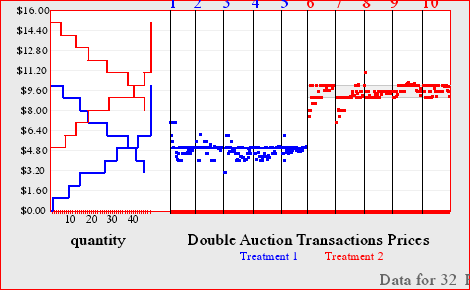
The following image shows how laboratory data is presented for a double auction. (Retrieved from http://veconlab.econ.virginia.edu/htm_small/da_06_small.png )
An Illustration

It is believed that Edward Chamberlin conducted the first experiment in economics. Chamberlin examined market conditions in his classroom in a controlled atmosphere, whose results deviated from the prevalent Walrasian conclusions. The rationale of experimental economics is that theory/models suggest general tendencies among the variables of interest. The strength of the general tendency is not provided by theory. In other words, theory cannot tell us about its explanatory power. This is where experimental economics makes its contribution. Also, this is the reason why one carries out field surveys and why econometricians look for a high R-square.

Initially, experimental economics seemed to be aping the sciences to a large extent. However, after reading Sunder’s account, I am begining to get convinced about its potential in understanding aggregate economic behaviour. Sunder wonders how we can study social beings by completely negating free will ‘ that is, by treating it as a science. The other option is to highlight the heterogeneity of human behaviour and refuse to come up with general tendencies. As he writes:

‘Hence we see the dilemma of social sciences. Do we abandon free will, personal responsibility, and special human identity; and treat humans like other objects of science’ That is, drop the ‘social’ qualifier, and become a plain
vanilla science’ Or, do we drop the ‘science,’ abandon the search for universal laws, embrace human free will and unending variation of behavior, and join the humanities’ Either way, there will be no social science left. Is there a place where we can keep the ‘social’ and the ‘science’ together”

Advances in computer technology assists economists working on aggregate economic variables. This is done by conducting computer simulations. The model can be taken from any theory ‘ Marxian, Walrasian, Ricardian, Keynesian, etc ‘ and specific behavioural rules can be assigned so as to arrive at some conclusions. But what is to be remembered is that, these computer simulations are tools which assist the policy maker and are not substitutes for theory. It must be noted that when assigning behavioural restrictions, we are negating the free will of the individual economic agents. As economists, we are used to making such an assumption ‘ utility maximization, bounded rationality, tit-for-tat strategy, satisficing, reciprocative behaviour are all aspects of an individual’s behaviour.

To conclude, experimental economics offers economics the following benefits. Firstly, it provides data for verifying/falsifying a particular hypothesis. Secondly, through computer simulations, aggregate economic behaviour can be replicated to a limited extent. And lastly, experimental economics provides a strong flavour of science to economics.

Reference

Sunder, Shyam (2007) ‘Determinants of economic interaction: behavior or structure’, Journal of Economic Interaction and Coordination.

Paul Samuelson: The Father of 'Modern Economics' Dies

All those who have studied economics for the past 50 years or so have heard about Samuelson – Foundations of Economic Analysis, Samuelson-Stopler theorem, Factor-price equalisation theorem, revealed preference theory, Bergson-Samuelson social welfare functions, non-substitution theorem, linear programming in economics, etc. The first one is his 1947 book which dominates economics teaching even today, directly or indirectly. Samuelson transformed economics into some sort of science (pseudo-science, as some call it)-social physics. [For more on this, go here]

Robert Lucas on Samuelson:

‘Samuelson was the Julia Child of economics, somehow teaching you the basics and giving you the feeling of becoming an insider in a complex culture all at the same time. I loved the Foundations. Like so many others in my cohort, I internalized its view that if I couldn’t formulate a problem in economic theory mathematically, I didn’t know what I was doing. I came to the position that mathematical analysis is not one of many ways of doing economic theory: It is the only way. Economic theory is mathematical analysis. Everything else is just pictures and talk.’ [Marginal Revolution and here]

SCARY!

In his Foundations, he is supposed to have popularised the views of Keynes. In fact, what he popularised is the neo-classical synthesis (IS-LM curves, which were created by Hicks). Hence, what we learn in most macroeconomics texts is not what Keynes said. Post-Keynesian economics is more closer to what Keynes said.

Despite his ‘ideas of good economics’, one needs to appreciate the works he carried out in different areas in economics – macroeconomics, public finance, international trade, consumer theory, capital theory and general equilibrium, etc.

In his initial editions of the Foundations, one could find a few pages devoted to the 1960 capital theory debates. However, with passage of time, the debate was relegated to footnotes. Now, in mainstream textbooks, capital theory is entirely omitted. In fact, Samuelson admitted the problems neoclassical microeconomics and general equilibrium run into because of their notion of capital. [More here]

I end with two questions.
Is mathematics the only way of studying economics and analysing economies’ [We mostly use calculus and game theory. Should we employ other kinds of mathematics’]

How reliable are textbooks’ It makes learning easy, but probably, a bit too easy.